






 Trap
 Normal
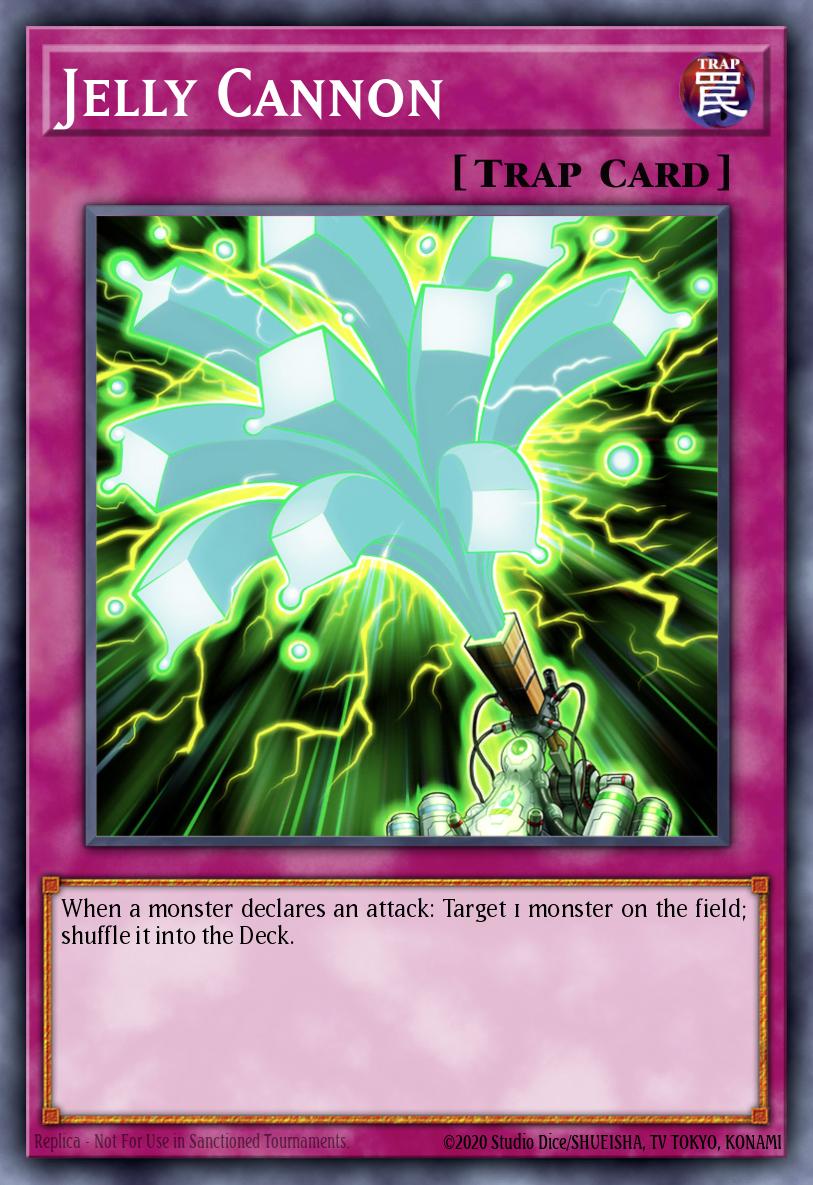
Jelly Cannon
View:
3700
When a monster declares an attack: Target 1 monster on the field; shuffle it into the Deck.
Jelly Cannon — Power Evaluation
Final Score: 53 ± 8 · Confidence: Medium
- Intrinsic: 55 · Deck: 53 · Meta: provisional
- Primary role: Removal / Negation
Why it scores here
Jelly Cannon is a conditional removal trap: when a monster declares an attack, it shuffles one monster on the field into the Deck, which removes the threat without a graveyard footprint. Its strength is portability (93 decks across 46 archetypes) and cheap slot cost, not its body or any combo role, since there is no combo evidence at all. The score is held back by the attack-declaration trigger, a 1-for-1 exchange with no card advantage, and no evidence of its speed or timing window, so high-value removal text does not earn points beyond what the trigger allows.
Axis scores
| Axis | Score | Evidence |
|---|---|---|
| Accessibility | 50 | Run in 93 of 93 sampled decks at an average of 1.55 copies, but no searchers or combo starts are recorded, so access rests on being drawn and set (observed; inferred for the set-turn timing). |
| Combo & Conversion | 15 | Zero recorded combo boards and no examples, so the only conversion evidence is the text, which yields one removal and no follow-up body (inferred). |
| Resource Economy | 45 | Shuffles one monster into the Deck for one card spent, with no refuel or draw, which is roughly even (verified from text; deck counts observed). |
| Effect & Interaction | 60 | Strong hard removal that answers an attacking monster with no graveyard trace, but it only triggers on attack declarations and does not negate effects (verified from text; inferred for the limit). |
| Material Utility | 0 | A Trap card with no monster body, so it is never usable as material or a name/level provider (verified from card frame and type). |
| Resilience & Flexibility | 40 | Single-zone card with no recursion and no recorded counters, so one interruption ends it; redundancy comes only from running multiple copies across decks (inferred; no counter data supplied). |
| Deck-Building Efficiency | 80 | A generic, non-garnet trap that fits 46 archetypes and runs at 1 to 3 copies with no lock, so it is cheap and splashable (observed from decks; verified that it is not a garnet). |
Calculation
Weight profile: Removal / Negation primary; no meaningful secondary role, so no blend. Intrinsic ≈ 55, Deck ≈ 53, Meta = provisional. Modifiers: none. Final formula: 0.40*Intrinsic + 0.60*Deck
Strengths
- Shuffles any monster on the field into the Deck, so the removal leaves no graveyard trace
- Portable across 46 archetypes in the sample, so it is a generic answer rather than a single-deck tool
- Low commitment: 1 to 3 copies per deck and no garnet or lock restriction
Weaknesses
- Triggers only when a monster declares an attack, so it does nothing against effect-only boards
- 1-for-1 exchange with no card advantage or refuel
- No combo evidence, so its conversion value rests on text alone
- Speed and set-turn timing are not supplied in the evidence
Counters / choke points
- Opponent boards that do not declare attacks (inferred from the trigger)
- Any interruption that negates or destroys a set trap before it can activate (inferred; no counter data supplied)
Best use
Generic answer to an attacking monster in any deck that runs spare trap space. Decks: Labrynth, Archfiend, Gunkan, Code Talker. Suggested copies: 1.
Evidence & gaps
- Verified: Card text: when a monster declares an attack, target 1 monster on the field and shuffle it into the Deck; Frame type is trap and the card has no monster body (no ATK/DEF/level); 93 of 93 sampled decks run it, average 1.55 copies, distinct archetypes 46
- Observed: Gameplay distribution: 61% of decks in gameplay type 4, 18% in type 7, 15% in type 3; Usage statistics cover only 2 archetypes (Fishborg 100% inclusion, Myutant 66.7%); Partner cards are generic staples such as Mystical Space Typhoon and Torrential Tribute
- Inferred: Removal role: the shuffle-into-Deck effect removes a monster without destruction or banishment, which is a removal action; Set-turn timing and speed are unverified, so the card may be held back as a set trap; Redundancy in deck is moderate given the 1.55 average copies
- Data gaps: no combos supplied, so combo conversion is text-only inference no guides supplied no speed (Normal/Continuous/Quick-Play) or set-timing information in the card text evidence no banlist token, assumed 3 copies (unlimited) usage statistics covers only 2 archetypes, so historical inclusion is thin